Application architecture.
Built around your business.
Connect applications, data and integration to the way your business works.
dForce provides UK application architecture consulting for ERP, PSA and CRM environments, including Sage Intacct, Certinia and Salesforce. We map your application landscape, agree data ownership and system boundaries, and plan the integrations and changes needed to support your business outcomes.
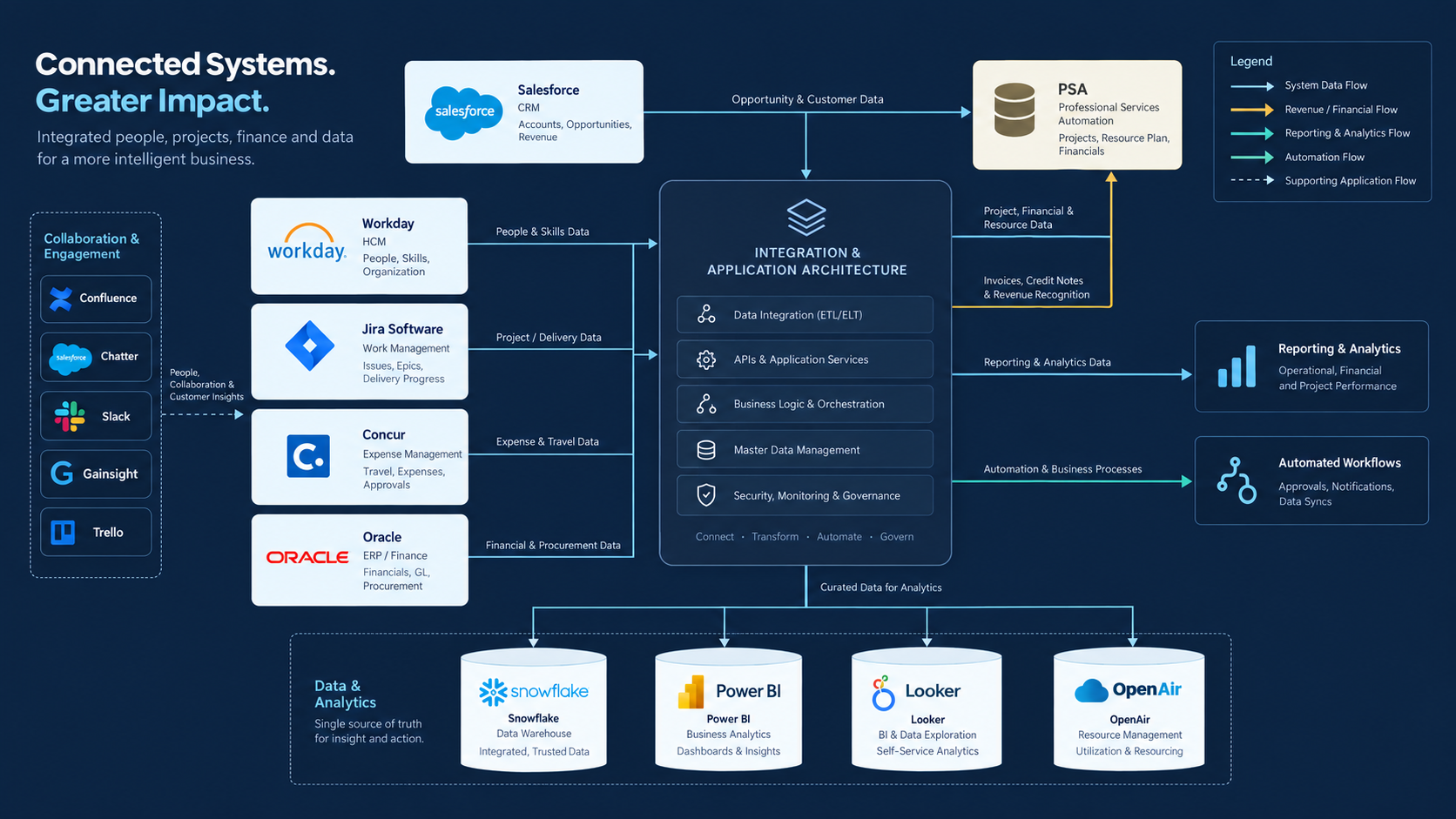
How we can help Understand the landscape before you change it.Technology decisions are rarely isolated. A change to one application can affect data, processes, reporting, integrations and the people who rely on them. Our application architecture work creates a shared view of how your systems operate today and how they need to work together tomorrow. Expand an area below to see what the work can include. Current-state application mappingMap the applications, owners, users and processes in your current landscape. Record the interfaces, manual hand-offs and dependencies that matter to your decision.
Target architecture and solution designAgree what each application should do and how the future landscape will support your operating model. Connect the architecture decisions to the detailed design and delivery work that follows.
Integration and data-flow assessmentDefine which information needs to move between applications, when it should move and how teams will know the transfer has succeeded.
Technology and vendor rationalisationAssess overlapping capabilities and the dependencies behind a change of application or vendor. Use the findings to inform investment and retirement decisions.
Roadmaps for scalable changeTurn the target architecture into a practical sequence of changes, with clear dependencies, owners and decision points.
| What good architecture delivers A stronger foundation for better decisions.AlignmentConnect technology decisions to business priorities, operating models and measurable outcomes. ControlMake dependencies, risks, ownership and data flows visible so teams can assess their impact on delivery. ScalabilityPlan for the capacity, integration, automation and platform changes your business needs, with explicit assumptions and dependencies. ConfidenceGive stakeholders a common view of the environment and a practical route from the current state to the target state. Example architecture deliverables
The depth and format of the outputs, together with the responsibilities for review and acceptance, are agreed for each engagement. |
Architecture that supports the whole operating model
From CRM and professional services through to ERP, reporting and specialist applications, we help you see how the pieces fit together. Connect the work with operating model advisory, solution design and architecture review, and implementation and integration.
Common questions
Application architecture: your questions answered.
What is application architecture?
Application architecture describes the roles of your business applications and how they work together. It defines application boundaries, ownership of key records, interfaces and dependencies. dForce uses it to connect the operating model with a practical system landscape for ERP, PSA, CRM, reporting and related applications.
How does application architecture differ from a review or solution design?
An architecture review assesses the current landscape and the options for change. Application architecture defines the responsibilities, boundaries and connections between applications. Solution design describes the processes, configuration and controls needed for an agreed requirement. dForce can connect these activities or scope them separately around the decision you need to make.
Can you work with our existing applications and legacy systems?
Yes. We assess which systems to retain, improve, connect, replace or retire. The review considers current processes, data, vendor commitments, interfaces and operating constraints. A replacement platform is not assumed to be the answer to every requirement.
How do you decide where data should be held?
We agree which application owns each important record and which systems need a copy or view of it. The design sets out who can create and update data, how changes move between systems, and how teams handle differences. Ownership, validation and reconciliation are agreed alongside the technical interface.
Can you assess Sage Intacct, Certinia and Salesforce together?
Yes. dForce assesses how the selected finance, services and CRM applications should work together, including the boundaries between customer, project, billing, recognition and accounting processes. Other applications you retain can form part of the review. The required connectors, configuration and integration work are confirmed for the agreed scope.
What outputs can we expect?
Depending on the agreed scope, outputs can include a current-state application map, a target architecture, an interface and data-flow view, a record of ownership and design decisions, and a prioritised change roadmap. We agree the level of detail, assumptions and acceptance responsibilities before the work begins.
How long does an architecture engagement take, and what does it cost?
The timetable and cost depend on the number of applications, processes, interfaces and stakeholders involved, the evidence available and the depth of assessment required. We agree the scope, workshops, outputs, customer responsibilities and estimate around your decision needs. Implementation services and software subscriptions are separate considerations.
Can dForce help implement and maintain the architecture?
Yes. We can support solution design, integration, migration, testing and implementation, or work with your chosen delivery team. We can also help establish architecture ownership and a process for reviewing future changes. Delivery and ongoing assistance are scoped separately around your requirements.
Ready to understand your application landscape?
Whether you need a strategic architecture review, a target-state design or help connecting the systems you already have, we can help define the right next step.
Start the conversation →